Without an Ebola vaccine, trust is the answer
The Bundibugyo Ebola outbreak currently unfolding in Eastern DRC may become the deadliest on record.[1] Currently, the only intervention available is community compliance with the guidelines of health systems that serve them. And compliance requires trust in these health systems.
The dominant narratives around the handling of the current Ebola epidemic point to several issues. One of the more complicated issues identified in the context of this outbreak is communities’ lack of trust in the health authorities responding to the crisis. But identifying trust gaps is not the same as knowing which lever to pull to rebuild it and ensure communities’ compliance with guidelines.
At ReD Associates, we have partnered with on-the-ground organisations in Low-and-Middle-Income Countries to understand the impact of the healthcare interventions they deliver on communities’ trust. This work has helped bridge the evidence gap between what local responses offer and what communities trust. Our bespoke Lancet-Global-Health-published trust measurement framework breaks trust down into its constitutive elements, identified through deep qualitative research in LMICs. We are able to quantify each of these elements. This approach has enabled us to identify where trust fractures, and how.
One of the perceptions this approach reveals is whether individuals believe their health system has their best interest at heart. This perception is shaped by four parameters: whether they believe the health system treats all groups fairly, regardless of income, ethnicity or gender, recognises their autonomy in making decisions about their own health, prioritises the health issues that communities care most about, and is capable of addressing the health issues communities face and rely on it for.
This tool shows that people in the DRC have lower levels of trust than the average in other African countries surveyed, that their health system is acting in their best interest. Health authorities and communities’ responses to the current outbreak illustrate why.
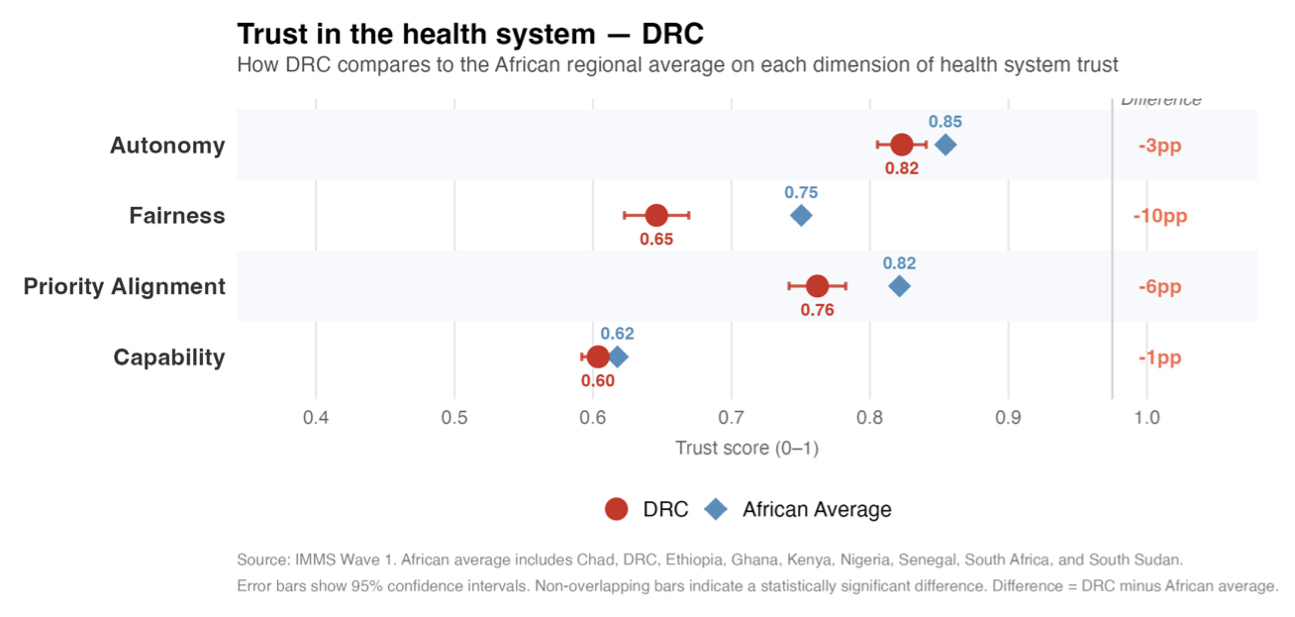
One of the dimensions of trust that has broken down is fairness.
Take grieving practices. At times of crisis, traditional Ebola treatment centres prioritise containment and distancing between patients and their families. Safe burial means surrendering a body that a family cannot touch, under protocols that clash with local customs. When communities are asked to forego important practices like this, they are asked to cede control over decisions that are most intimately theirs. When people feel the system acts on them rather than with them, their sense of fairness breached, which in turn erodes trust.
Another dimension is whether communities believe the health system prioritises what they need beyond the immediate demands of the crisis.
Decades of health delivery challenges are not erased by short-term influxes of personnel and resources. Experiences of institutions that have historically failed or harmed communities during Ebola virus outbreaks shape communities’ current perceptions and behaviours. The same communities witness health authorities appear in regions where primary healthcare is not usually accessible fuelling scepticism and distrust.[2] [3]
The pattern is consistent: communities affected by Ebola have rational grounds for believing the system does not prioritise their best interest. These stem from how responses have been designed and historically enforced. Responses to past Ebola outbreaks in the DRC have leveraged militarized interventions and coercion. Such crisis management inevitably shapes what communities come to expect from institutions, long after the disease is gone.[4]
Getting ahead of breaches in trust is both preparation for a future outbreak, and essential to responding to the current one. Should a Bundibugyo vaccine become available, uptake will depend on trust in a health system which today is fractured. For novel vaccines, where communities have no prior experience to draw on, trust in the promise of the health system indicates intent to vaccinate independently of trust in the vaccine and its delivery. A poorly managed response now erodes both. To anticipate this, knowing where trust is breaking down – and why – is complementary to knowing where the virus is spreading. While we currently do not have a complete picture of viral transmission, we do have a diagnostic of where trust has collapsed.
The committed $518M Ebola outbreak response plan has pillars for emergency coordination, surveillance, laboratory testing, risk communication, community engagement, and the continuity of essential health services. The latter two would benefit from leveraging this existing trust diagnosis, not as a sub-component but as a precision instrument that identifies where the failure sits and what to fix.
Trust data should be treated as disease surveillance data: collected, tracked, and acted upon.
[1] Mahase E. (2026). Ebola in numbers: Aid agencies warn current outbreak may become "deadliest on record."BMJ, 393:e727772.
[2] Omasumbu et al. (2026). Reorienting Ebola Care Toward Human-Centered Sustainable Practice. Nature Medicine, 32:394-5.
[3] Dhillon & Kelly (2015). Community Trust and the Ebola Endgame. NEJM, 373(9):787-9.
[4] Sweet R. & Kasali N. (2024). Public health intervention amidst conflict: Violence, politics, and knowledge frames in the 2018-20 Ebola epidemic in Democratic Republic of the Congo. Social Science & Medicine, 350:116854.
